
How Planning and Design Shape Traffic Safety
Stakes of Urban Mobility
The stakes of traveling on America’s roads are reaching an all-time high. According to the Governors Highway Safety Association, in 2024, 7,148 pedestrians were killed in vehicle collisions, a nearly 20% increase from 2016. While vehicle fatalities have declined in recent years, National Highway Traffic Safety Administration (NHTSA) Chief Counsel states “America’s traffic fatality rate remains high relative to many peer nations”. While these statistics can be alarming, the Federal Government, state departments of transportation (DOTs), and municipalities have begun planning and designing facilities with improved safety metrics and outcomes. These plans, often called Vision Zero plans, seek to eliminate roadway fatalities through engineering, education, and enforcement.
Within GBA’s current markets, both the Kansas Department of Transportation (KDOT) Missouri Department of Transportation (MoDOT) have set goals to eliminate fatal and serious injury crashes on state facilities. The KDOT Drive to Zero campaign aims to accomplish its goals by influencing traffic safety through “education, enforcement, engineering, and emergency response”. Similarly, the MoDOT Show Me Zero campaign has a more explicit goal of eliminating all roadway fatalities by 2030.
Safe System Approach
Most Vision Zero plans are centered on the Safe System Approach, which is based on the idea that highway safety is a multifaceted problem requiring a multifaceted set of solutions. While the specific terms may vary by source, the Safe System Approach is generally divided into actionable elements and guiding principles.
Actionable Elements
|
Guiding Principles
|
GBA’s Role in Safety Designs
GBA’s traffic and transportation team has played a proactive role in recommending safety improvements as part of preliminary engineering studies, as well as implementing those improvements during the design phase.
As part of the K-68 Access Management Plan, GBA recommended changes in access to a large arterial in Ottawa, Kansas, with the goal of improving safety on the corridor, while allowing for future development. As the future development is planned to be primarily auto-centric, pedestrian and bicyclist facilities are proposed to be located off street and serve both as connective and recreational facilities. The K-68 Access Management Study won a 2026 American Council of Engineering Companies (ACEC) Kansas Chapter Engineering Excellence Award.
Similarly, the South Liberty Parkway Roundabout Feasibility Study examined locations and configurations of roundabouts on an undeveloped corridor in Liberty, Missouri. The study highlighted the safety benefits of the recommended roundabouts compared to traditional signalized intersections. The conceptual design integrated the existing sidewalk and shared-use path, while including enhanced crosswalks to improve multimodal safety at the roundabouts. This proposed roundabout corridor will help lower vehicular speeds, reduce fatal and injury crashes, and provide safe crossings and facilities for all users.
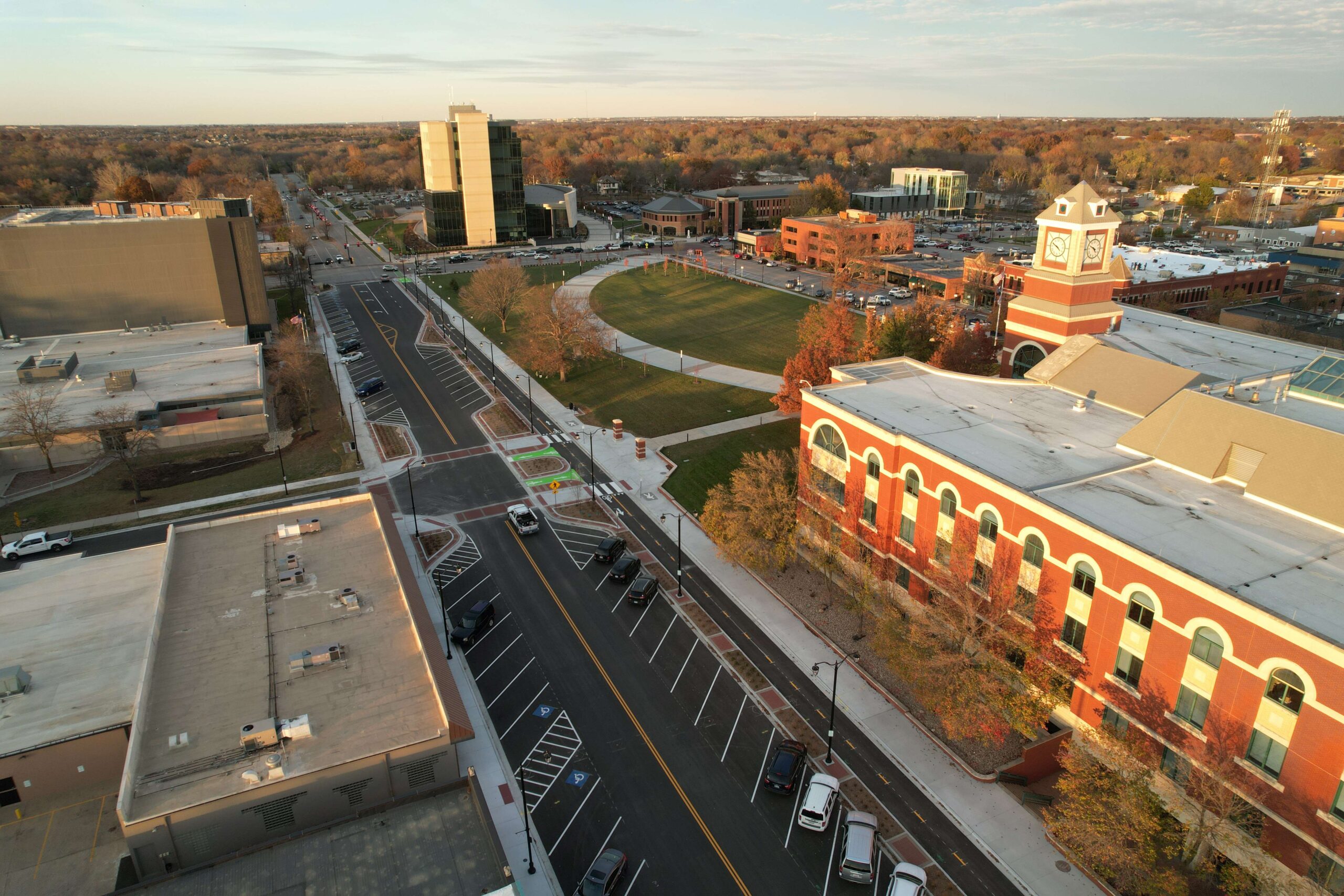
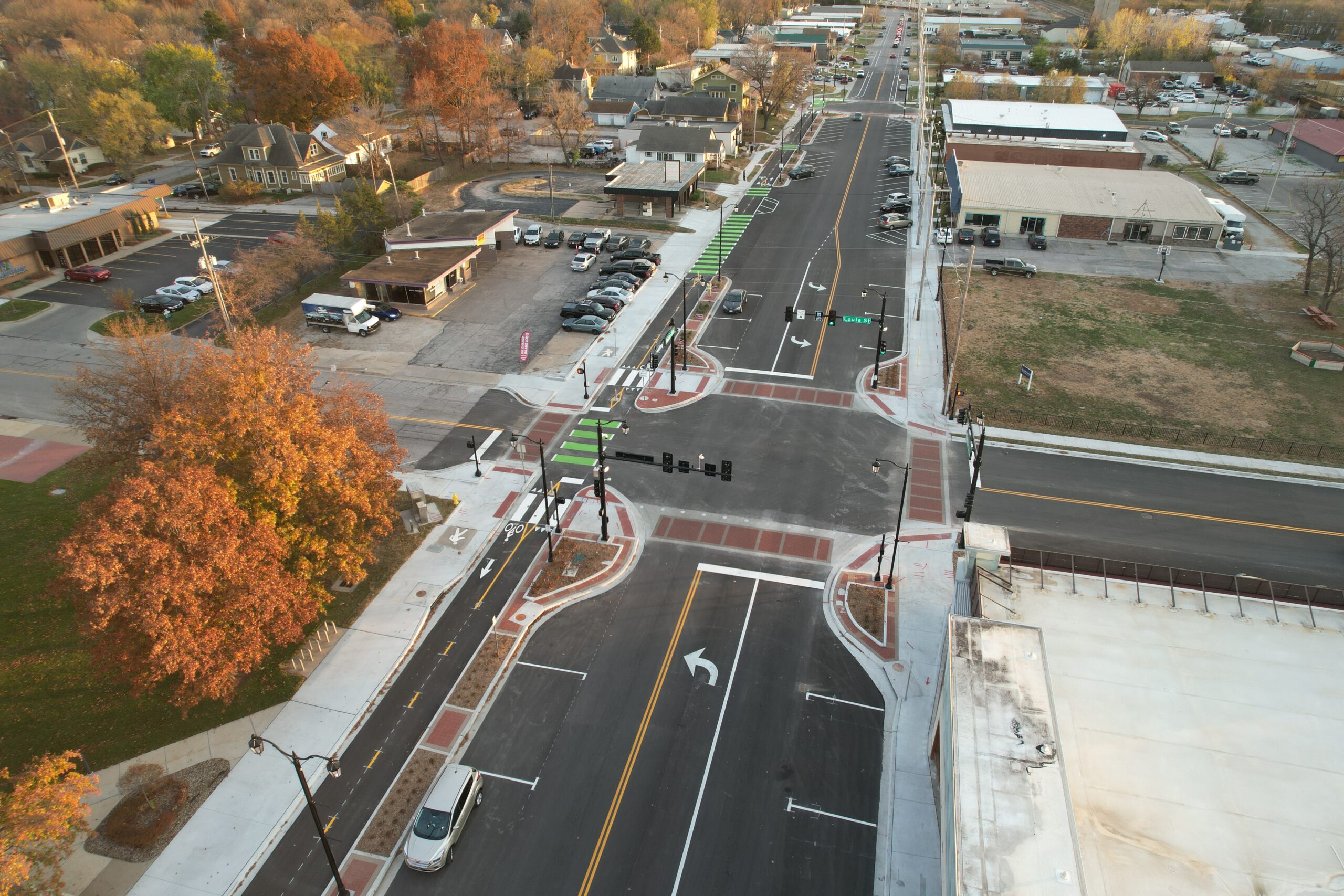
GBA also has extensive experience designing pedestrian, bicycle, and other Safe Systems facilities. Completed in 2023, the Kansas Avenue Streetscape project reimagined a major roadway through the heart of downtown Olathe, Kansas. The project added the first separated two-way cycle track in the state of Kansas, improving safety and multimodal transportation through the area.
Designing for Safety
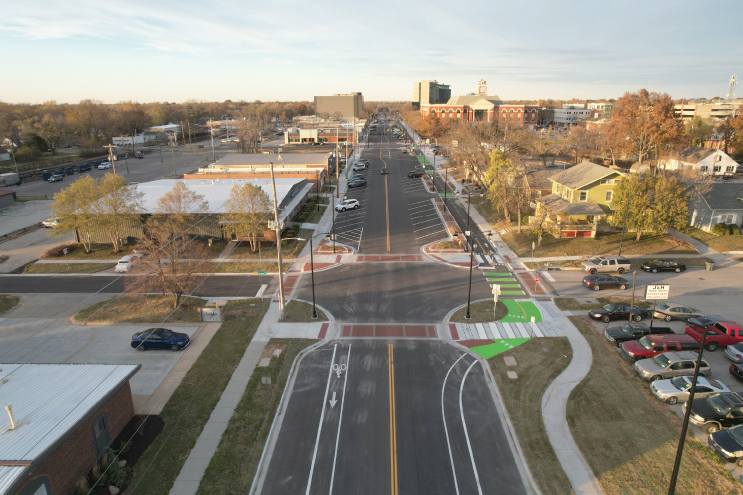
As discussed as part of the Safe Systems Approach, redundancy in the system is crucial. While there are multiple actionable items and guiding principles, engineering consultants typically work in the safer roads and safer speeds spaces. When completing a study, preliminary analysis, or design recommendation, GBA’s engineers can work with the client to determine reasonable safety improvements. While constraints may be present, it is often possible to make tangible pedestrian, bicycle, and vehicular safety improvements to a facility. Small changes to design elements, such as lane widths, pavement marking, lighting, signing, and curb radii can have tangible safety benefits without inflating project costs. Ultimately, facilities should be designed so that all users, regardless of mode, feel safe to travel from origin to destination.
Land Use, Community Planning, and Multimodal Integration
A less discussed part of traffic in planning safety, yet arguably more crucial, is the role of land use, community planning, and multimodal integration on traffic safety. Land use and transportation are directly related, with the densities and uses of an area impacting the infrastructure needed. For new development, the existing infrastructure often impacts the types and densities of development that occur.
Less dense development, such as single-family homes, big box stores, and industrial facilities, encourage, or often require, automobile centric facilities and design. These can include large arterials with many driveways, interstate highways, or other wide, high-speed facilities. These facilities, while necessary in certain locations for regional traffic flow, are often incompatible with or discourage bicycle and pedestrian travel, even if dedicated multimodal infrastructure is provided.
In contrast, more dense or mixed-use development can encourage walking, bicycling, and lower vehicle speeds. In some areas, robust public transport alternatives exist to supplement this system, making citywide travel possible by means other than automobile.
In considering the design of facilities, matching the context of the area could be considered the best approach. While bicycle and pedestrian facilities are necessary and encouraged, it may be more beneficial to provide a shared-use off-street pathway along a busy arterial or collector roadway, rather than providing an on-street facility. Furthermore, thoughtful design of bicycle and pedestrian networks can provide cost savings and increased usage. As destinations for pedestrians and bicycles may lie along well traveled roadways, it may be beneficial to place an on-street bicycle route along a lower volume parallel roadway. This provides safety benefits to cyclists, while reducing the cost of constructing bicycle facilities on the primary arterial.